

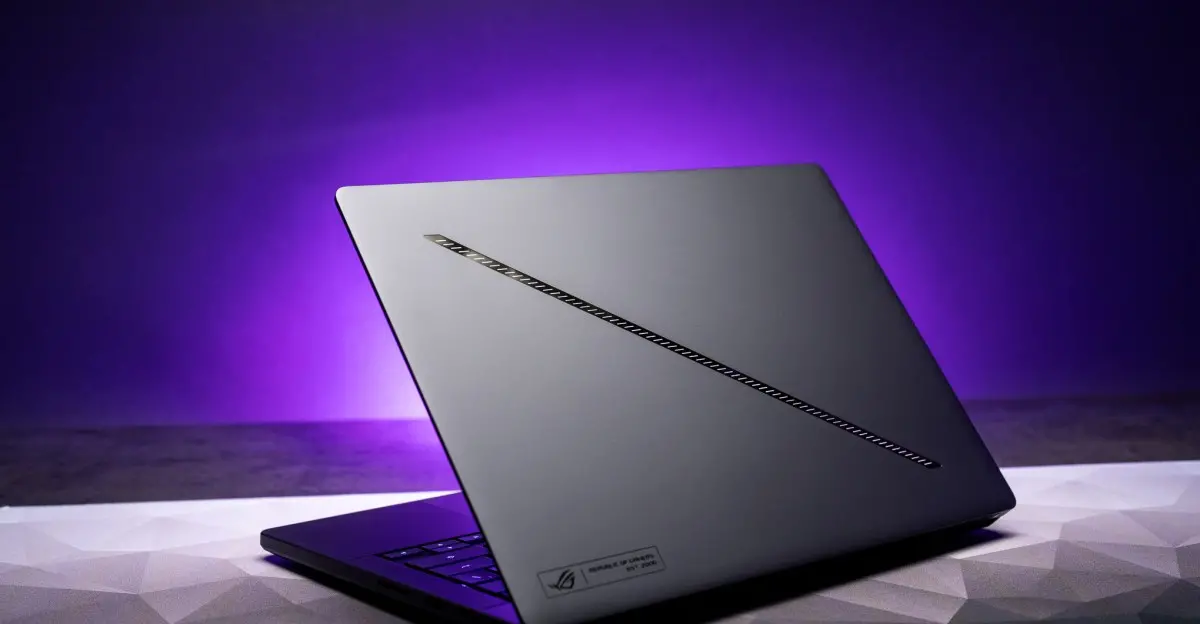
The Asus ROG Zephyrus G14 has been a staple in the gaming laptop market since its debut in 2020. Over the years, it has evolved through facelifts, chip bumps, and a full redesign. Now, in 2026, Asus introduces a new flagship model that swaps AMD processors for Intel's latest Panther Lake CPUs. This iteration also brings a long-awaited feature: a full-size SD card slot. For many creative professionals and gamers seeking a single device for both work and play, the G14 has always been a compelling option. However, the new model's starting price of $3,450, climbing to $3,600 for the review configuration, raises questions about its value proposition.
Design and Build Quality
The 2026 G14 maintains the sleek, minimalist design introduced with the 2024 redesign. It measures 12.24 x 8.66 x 0.63-0.72 inches and weighs 3.48 pounds, making it comparable to a 14-inch MacBook Pro. The chassis is constructed from lightweight yet durable materials, and the lid features an animated slash lighting effect with more LED segments than before. The bottom cover now uses circular hole vents instead of rectangular slots, improving airflow and aesthetics. The overall build quality is excellent, with a premium feel that justifies its high price point. The keyboard offers deep key travel and a satisfying tactile response, rivaling even Lenovo's ThinkPads. The mechanical trackpad is large and provides a firm, satisfying click, though it does not click in all four corners like some competitors. Most gamers will likely use an external mouse anyway.
Display and Audio
One of the standout features of the new G14 is its 14-inch OLED display with a resolution of 2880 x 1800 and a 120Hz refresh rate. The screen is incredibly sharp and vibrant, offering rich colors and deep blacks. In SDR mode, the display reaches 500 nits of brightness, a 100-nit improvement over the previous generation. HDR peak brightness has more than doubled, from 500 nits to an impressive 1,100 nits. This makes the laptop suitable not only for gaming but also for professional photo and video editing. The audio system is equally impressive, with six speakers delivering rich, full sound with a noticeable stereo soundstage. It is one of the few Windows laptops that can compete with the MacBook Pro in terms of audio quality. Whether you are watching movies, listening to music, or playing games, the G14 provides an immersive auditory experience.
Performance and Hardware
The review unit is powered by a 16-core Intel Core Ultra 9 386H processor paired with an Nvidia GeForce RTX 5070 Ti Laptop GPU, 32GB of soldered LPDDR5X RAM, and a 1TB NVMe SSD. The GPU has a peak TGP of 130W, slightly higher than last year's 120W, allowing for modest performance gains. In benchmarks, the G14 performs admirably. Geekbench 6 scores show a single-core result of 2909 and a multi-core score of 17,145. The GPU achieves an OpenCL score of 162,373. In Cinebench 2026, the laptop scored 517 in single-core and 4,645 in multi-core. Real-world performance is equally strong. Editing RAW photos in Adobe Lightroom Classic feels snappy, even on battery power with minimal fan noise. The laptop handles heavy multitasking with ease, though exporting videos in Premiere Pro takes longer than some competitors. For gaming, the G14 delivers excellent frame rates. In Battlefield 6, it averages 65-70fps at native resolution with High settings. Helldivers 2 runs at 80-90fps without DLSS, and Marathon manages around 70fps with DLSS set to Quality. The bottom of the laptop gets hot during extended gaming sessions, but the keyboard deck remains comfortable, with only slight warmth on the left palm rest.
Battery Life and Connectivity
One of the biggest improvements with the Intel Panther Lake chip is power efficiency. The G14's 73Wh battery delivers exceptional longevity for a gaming laptop. In our battery rundown test, it lasted over 17 hours, more than double the 8.5 hours of the previous AMD-based model. In real-world use, it can easily get through a full workday—over 10 hours of mixed usage with multiple Chrome tabs, Slack, and music streaming at 80% brightness. When gaming or performing GPU-intensive tasks, battery life drops to around five to six hours, but that is still respectable. The laptop supports fast charging via the included proprietary adapter or USB-C Power Delivery. Port selection is generous: one Thunderbolt 4 USB-C (with DisplayPort and Power Delivery), one USB-C 3.2 Gen 2, two USB-A 3.2 Gen 2, HDMI 2.1, a full-size SDXC UHS-II card slot, and a 3.5mm audio jack. The inclusion of Thunderbolt 4 and the full-size SD slot are particular highlights for content creators who need high-speed data transfer.
Pricing and Value
The 2026 G14's price is its most controversial aspect. The base model starts at $3,450, and the review configuration costs $3,600. This represents a roughly $1,000 premium over the previous generation with similar specs. Asus has stated that global memory shortages and the cost of new Intel processors are driving prices up, but the value proposition that made the original G14 so popular is now diminished. For the same price, one could purchase a 14-inch MacBook Pro with an M5 Pro chip and a dedicated gaming console or handheld, offering better overall performance in specific tasks. Even last year's G14 with an AMD Ryzen 9 and RTX 5060 can be found for under $2,000 on sale, making it a more sensible choice for most buyers. The new G14's advantages—better battery life, a brighter screen, an SD card slot, and Thunderbolt 4—are significant, but it is hard to justify the $1,000 premium unless these features are absolutely critical.
Comparison to Competitors
Compared to other laptops in its class, the G14 holds its own but faces stiff competition. The MacBook Pro 14 with an M5 chip outperforms it in CPU-intensive tasks and offers longer battery life, but it cannot play Windows games at the same level. The Razer Blade 16 and Asus's own Strix Scar 16 offer higher GPU performance and larger screens, but they are bulkier and have shorter battery life. The G14 strikes a unique balance between portability, performance, and battery life, making it an excellent choice for professionals who need a single device for both demanding creative work and gaming. However, the high price may push budget-conscious buyers toward the previous generation or alternative brands.
The Asus ROG Zephyrus G14 (2026) is a technological marvel that packs desktop-class performance into a slim, lightweight chassis. Its stunning OLED display, exceptional battery life, and thoughtful port selection make it a dream laptop for many. Yet, its astronomical price tag places it firmly in the luxury category. While it is arguably the best all-in-one Windows laptop currently available, the value for money is questionable. For those who can afford it and truly need the combination of performance, portability, and battery longevity, it is an outstanding choice. For everyone else, the previous generation models offer similar capabilities at a much more reasonable cost.
Source: The Verge News