

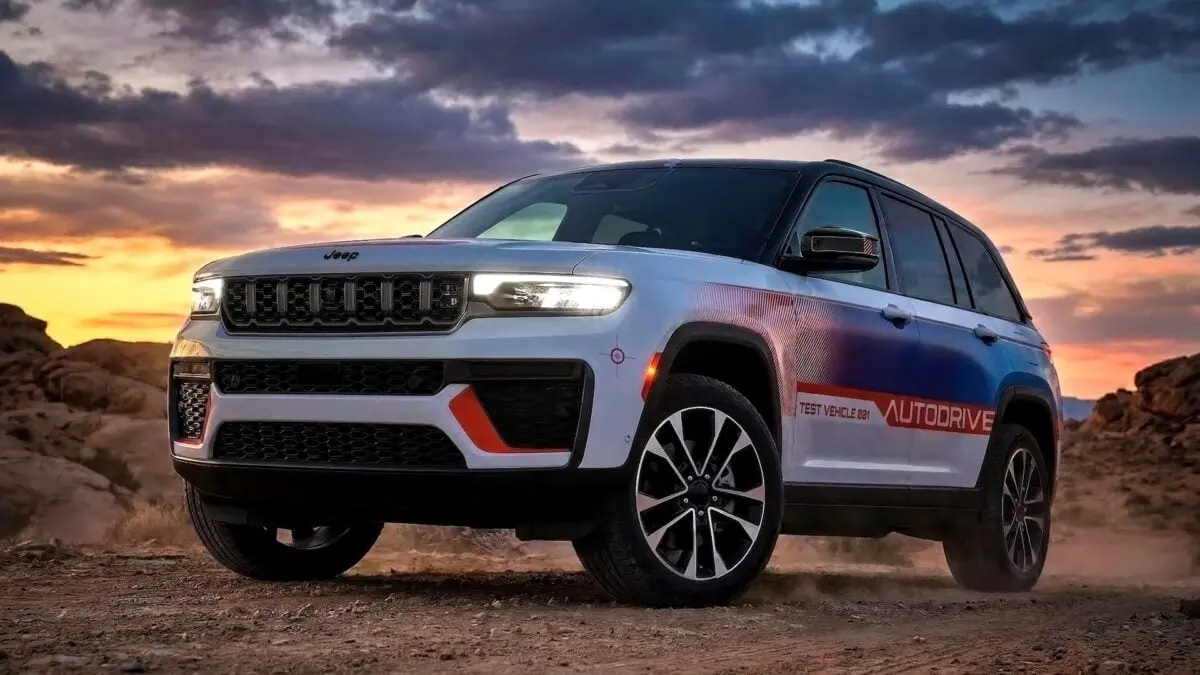
As robotaxi services steadily pop up in cities around the world, self-driving technology in commercial passenger cars has been slow to catch up. Stellantis, the parent company of Jeep, Ram, Dodge, Fiat, and several other car brands, is the latest automaker to announce plans to bring more advanced automated driving capabilities to its vehicles. The company recently unveiled a new strategic technology partnership with U.K.-based startup Wayve, aiming to integrate Wayve’s AI Driver system into Stellantis’ STLA AutoDrive platform.
This collaboration could eventually equip some Stellantis vehicles with hands-free, supervised driving technology that works on both city streets and highways, similar to systems already available on Tesla and Rivian vehicles. Stellantis and Wayve are describing this first iteration as a Level 2++ system, meaning drivers would still need to pay attention to the road and supervise the vehicle as it drives. The first vehicle integration is planned for North America in 2028. Stellantis says the platform can support more advanced automated driving features down the road as regulations and customer expectations evolve.
Key Facts from the Announcement
- Partnership: Stellantis partners with London-based autonomous driving startup Wayve.
- Technology: Wayve’s AI Driver software integrates with the STLA AutoDrive platform to offer Level 2++ hands-free driving.
- Timeline: First integration in North America is planned for 2028, with prototypes already developed on the Jeep Cherokee platform in under two months.
- Brands Involved: Initially, the tech will be available on Jeep, Ram, and Dodge vehicles, with potential expansion to other Stellantis brands.
- Investors: Wayve closed a $1.2 billion Series D round from SoftBank, Microsoft, Nvidia, and Uber, plus a separate $60 million investment from AMD, Arm, and Qualcomm Ventures.
- Other Partnerships: Uber plans to use Wayve for robotaxis in London starting in 2026; Nissan will integrate Wayve tech into its cars from 2027.
Deep Dive into Wayve’s Approach
Founded in 2017, Wayve is a London-based startup that develops autonomous driving software based on a unique camera-centric approach. Unlike many competitors that rely on high-definition maps, Lidar, and detailed pre-mapping, Wayve’s system learns directly from real-world traffic scenarios using cameras and machine learning. This theoretically eliminates the need for detailed maps, making the technology vehicle-agnostic and adaptable to everything from passenger cars to delivery vans. The company’s AI Driver software is designed to be integrated with existing automotive platforms, allowing automakers to add self-driving capabilities without building the technology from scratch.
Wayve’s approach has attracted significant investment from major technology and automotive players. Earlier this year, the startup announced it had closed a $1.2 billion Series D investment round with a range of investors, including SoftBank, Microsoft, Nvidia, and Uber. Just last month, Advanced Micro Devices (AMD), Arm, and Qualcomm Ventures announced a separate $60 million investment in the company. Uber’s investment is specifically aimed at supporting Wayve-powered robotaxis on the Uber platform, with the companies intending to launch their first service in London in 2026 and expand across multiple markets.
Industry Context
The move by Stellantis comes at a time when consumer adoption of self-driving features is still limited. While companies like Tesla and Rivian have offered Level 2 and Level 2+ systems for years, most traditional automakers have been cautious. General Motors’ Super Cruise and Ford’s BlueCruise are examples of hands-free highway driving systems, but they are restricted to divided highways and often require detailed mapping. Wayve’s system aims to work on both highways and city streets without pre-mapping, which could give Stellantis a competitive advantage in the market.
Level 2++ describes a system that can handle steering, acceleration, and braking in a wide range of conditions, but the driver must remain attentive and ready to take over at any moment. This is similar to Tesla’s “Full Self-Driving” (FSD) and Rivian’s “Highway Assist” system. The term “++” suggests that the system goes beyond typical Level 2 capabilities by allowing for automated lane changes, traffic light and stop sign recognition, and navigation on complex roads.
Stellantis’ STLA AutoDrive platform is designed to be scalable and modular, enabling the company to introduce different levels of automation across its various brands. By partnering with Wayve, Stellantis can leverage the startup’s advanced AI without developing the entire system in-house. This approach mirrors trends in the automotive industry, where many OEMs are forming partnerships with technology companies to accelerate development.
Future Implications
The partnership signals Stellantis’ commitment to advancing automated driving technology, particularly in its iconic American brands like Jeep, Ram, and Dodge. Jeep, known for its off-road capability, and Ram, a leader in pickup trucks, could benefit from hands-free driving systems that reduce driver fatigue on long highway journeys. Dodge, with its performance-oriented lineup, might also see integration for high-speed driving scenarios.
Wayve’s CEO Alex Kendall noted in a press release: “This agreement marks an important next step for Wayve and Stellantis in scaling our technology together. Our teams have already demonstrated how quickly the Wayve AI Driver can be integrated across Stellantis’ vehicle platforms, bringing up a prototype in less than 2 months.”
While no specific models have been named, the prototype was built on the Jeep Cherokee platform, suggesting that the first production vehicles could be based on that platform or other models in the Jeep lineup. Stellantis also hinted that as regulations evolve, the platform can support higher levels of automation, potentially Level 3 or Level 4, where the vehicle can drive itself in certain conditions without driver supervision.
The rise of AI-powered autonomous driving software like Wayve’s is reshaping the automotive industry. Traditional suppliers of radar and Lidar sensors may face less demand if camera-only systems prove reliable. Wayve’s success could also encourage other automakers to explore similar partnerships, accelerating the adoption of self-driving technology in passenger vehicles.
In summary, Stellantis’ partnership with Wayve represents a significant step toward bringing hands-free, supervised driving to mainstream American vehicles. With a first integration planned for 2028, drivers of Jeep, Ram, and Dodge vehicles could soon experience the convenience of automated driving on both highways and city streets, all while keeping their hands free and their eyes on the road.
Source: Gizmodo News