

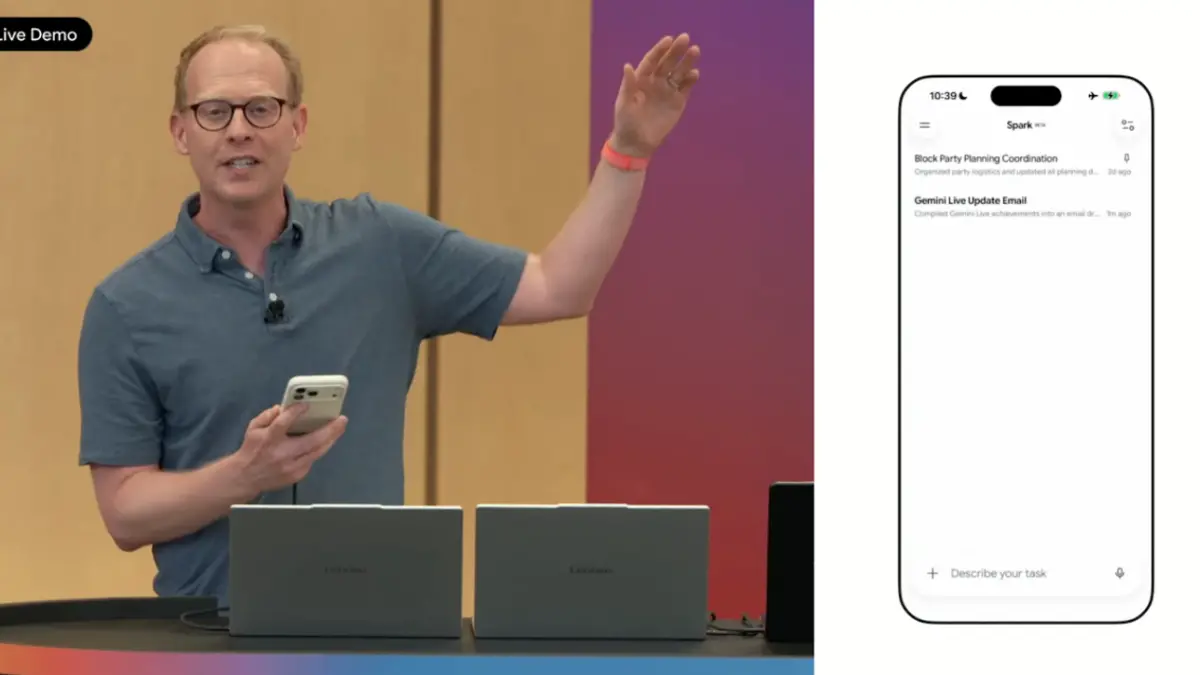
OpenClaw started a mini-revolution in the AI world by showing what was possible with AI agents, and at Google I/O 2026, the company finally unveiled its own AI agent. At its annual developers conference, Google introduced Gemini Spark, a personal AI agent that can draw on users' personal files while leveraging Gemini intelligence. During the keynote address, Google CEO Sundar Pichai said a beta of Gemini Spark would soon be available to Google AI Ultra subscribers, the company's premium AI subscription plan. In addition, Pichai said that Spark will run on the newly announced Gemini 3.5 Flash model.
While OpenClaw has become hugely popular in the AI and early-adopter communities, Google has a massive reach. Billions of people use Google products, and the company says its Gemini app has 900 million monthly active users. So, Gemini Spark could bring agentic AI into the mainstream for the first time. Here's why Gemini Spark may have an edge over tools like OpenClaw.
Gemini Spark is a cloud-based AI agent
Famously, OpenClaw runs on a local device such as a Mac Mini. Shortly after the tool became a viral hit (first under the name Clawdbot, then Moltbot), Mac Minis quickly sold out at Amazon and other retailers. However, Gemini Spark is a fully cloud-based AI agent. That makes it far more beginner-friendly, as there's no hardware or complicated installation process to worry about. And when you close your laptop, Spark keeps working.
Cloud-based AI agents have distinct advantages over local ones. They can leverage the vast computational resources of Google's data centers, allowing for more complex reasoning, faster response times, and the ability to handle multiple tasks simultaneously. For users, this means no need to purchase expensive hardware or manage local configurations. The agent is always available across devices—desktop, Android, and iOS. Additionally, because Spark runs in the cloud, it can be updated seamlessly without user intervention, ensuring it always has the latest capabilities and security patches. This model also allows Google to offer Spark as part of a subscription service (AI Ultra), reducing the upfront cost for consumers.
Gemini Spark will be able to run 24/7 in the background, with no additional devices required. This persistent operation means tasks like monitoring emails, summarizing documents, or executing scheduled actions can happen continuously, even when the user is offline. The cloud infrastructure also enables Spark to handle intensive tasks such as real-time language translation, video analysis, and complex data aggregation without draining the user's device battery or processor.
Gemini Spark will have better access to your data
Second, if you're already a Google user, then Gemini Spark will have native access to your Gmail, Google Docs, and Google Drive. So, if you ask Gemini Spark to plan an event, it can pull in contacts from Gmail, artwork from Google Drive, and a schedule from Google Docs. It will also be built into Google Chrome and works on desktop, Android, and iOS devices. Yes, all of this can be accomplished if you grant OpenClaw access to all of these tools, but Gemini Spark will make this process instantaneous.
Native integration with Google's ecosystem is a game-changer. OpenClaw, being a third-party tool, relies on APIs and user-granted permissions that may have latency, require additional configuration, or break due to API changes. In contrast, Google controls both the AI agent and the underlying services, allowing deep integration at the system level. This means Spark can access your Google Calendar, Photos, Keep notes, and even your YouTube watch history (with permission) to provide highly personalized assistance. For example, Spark could automatically suggest a meeting time based on everyone's calendar, draft an email using your writing style, and attach relevant files from Drive—all in one command.
Moreover, this integration extends to Google's enterprise suite. Business users who rely on Google Workspace will find Spark can interact with shared drives, team calendars, and company documents, streamlining workflows across organizations. The agent can also leverage Google's knowledge graph and search capabilities to provide context-aware answers, combining personal data with web intelligence.
However, this deep access does raise important privacy considerations. Google has stated that Spark will adhere to strict data governance policies, with user data not being used to train the model without explicit consent. Users will have granular controls over what data Spark can access and for how long. This is a critical differentiator from OpenClaw, which, being open-source, gives users full control but also places the burden of security and privacy management on them.
Cybersecurity peace of mind
OpenClaw has a DIY ethos, and, because it has such a high level of control over your hardware, it can be a big cybersecurity challenge. Some of those problems have been addressed now that OpenClaw is a part of Anthropic, of course. Still, billions of people are already familiar with Google and trust it with their emails, private documents, and photos. Presumably, Spark will be protected with the full might of Google's cybersecurity.
Google invests heavily in security infrastructure, including advanced threat detection, encryption at rest and in transit, and a dedicated security team that monitors for vulnerabilities. For Spark, this means built-in protections against prompt injection, data exfiltration, and unauthorized actions. Google also announced a new way of stopping AI agents like Spark from overspending your money. Google will be introducing something called Agent Payments Protocol (AP2). Google says this protocol stops agents from going rogue and making purchases you didn’t intend. Users will be able to place strict limits on how much Spark can spend, what it can purchase, and which merchants it can use.
The Agent Payments Protocol is a significant innovation for AI agents that interact with financial services. It works by requiring explicit user authorization for each transaction, with the agent presenting a clear summary of what it intends to purchase and at what cost. Users can approve or deny in real-time, or set predefined spending limits. This adds a layer of protection against potential exploits where malicious prompts could trick the agent into making unauthorized purchases. AP2 is built on Google's existing payment infrastructure, ensuring compatibility with Google Pay and major credit cards.
Furthermore, Google is introducing Gemini Spark slowly, and a beta will be available soon for AI Ultra subscribers. That lets Google test Spark with Gemini power users before launching it to everyday users. This phased rollout allows Google to identify and fix security issues, gather feedback, and fine-tune the agent's behavior in real-world scenarios. It also gives early adopters a chance to influence the product's direction.
Beyond security, Google's brand trust is a major asset. While OpenClaw has a passionate community, many users are wary of granting deep system access to a third-party tool. Google's established reputation for handling sensitive data (e.g., Gmail, Google Photos) provides a level of comfort that OpenClaw cannot easily match.
Additional Advantages and Context
Beyond the three reasons, several other factors could tip the scales in Gemini Spark's favor. One is the integration with Google's vast array of services, including Google Maps for location-based tasks, Google Flights for travel planning, and Google Assistant for voice interaction. Spark is designed to be a unifying layer across these services, allowing users to orchestrate complex workflows with natural language.
Another is the use of the Gemini 3.5 Flash model, which Google claims offers superior reasoning and speed compared to OpenClaw's underlying model. Google has been investing heavily in multimodal AI, and Spark can understand and generate text, images, code, and even audio. This makes it versatile for tasks like creating presentations, analyzing charts, or transcribing meetings.
The cloud-based nature also enables continuous learning and personalization. Over time, Spark can learn user preferences, habits, and communication styles, becoming more effective. For example, it might automatically prioritize emails from certain contacts, suggest recipes based on dietary restrictions, or remind you of upcoming bill payments.
However, OpenClaw has its own strengths: it is open-source, highly customizable, and can run completely offline. For users who value privacy above all else and have the technical expertise to manage their own infrastructure, OpenClaw remains a compelling option. But for the average consumer, Gemini Spark offers a more accessible, secure, and integrated experience.
Google is introducing Gemini Spark slowly, and a beta will be available soon for AI Ultra subscribers. That lets Google test Spark with Gemini power users before launching it to everyday users. For all these reasons, Gemini Spark could be the first AI agent used by countless internet users.
Source: Mashable News