

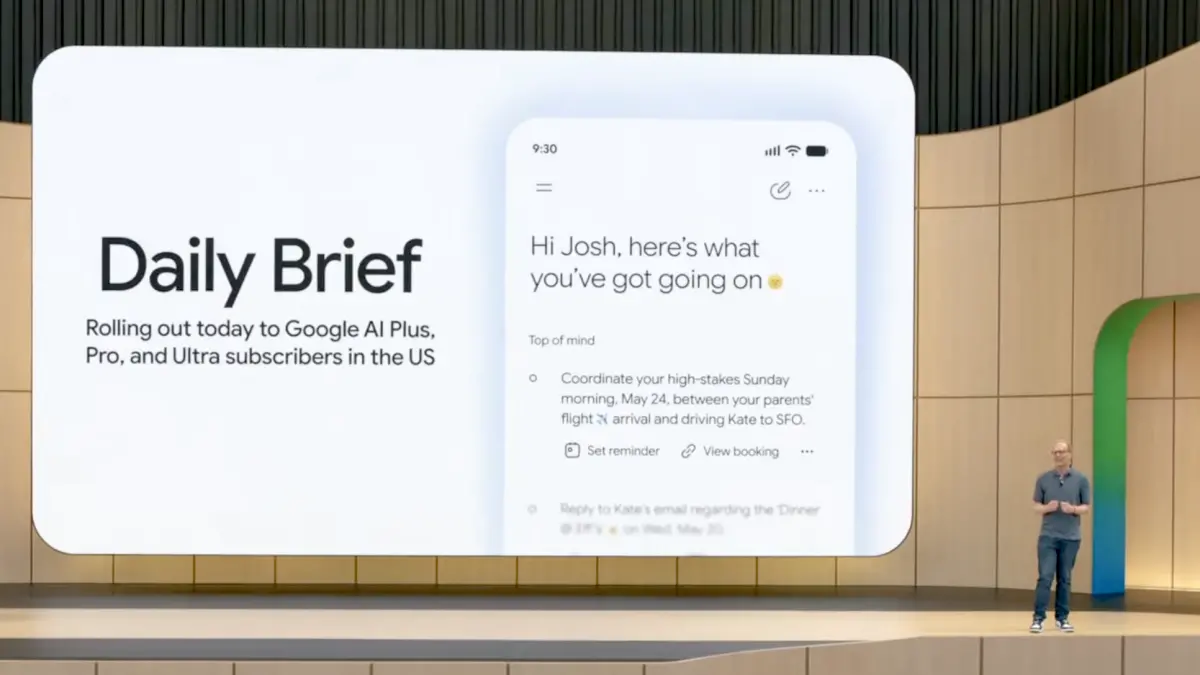
Google is betting big on personalization with its latest AI initiative: the 'Daily Brief.' This feature, currently in internal testing, aims to transform how users start their day by delivering a curated stream of relevant information. Unlike generic news aggregators, the Daily Brief will learn individual preferences, behavioral patterns, and contextual needs to serve up a unique mix of news, weather, calendar updates, reminders, and even smart home statuses.
What Is the AI-Driven 'Daily Brief'?
The concept of a daily briefing is not new. Apple's Siri offers a morning summary, and Amazon's Alexa provides a flash briefing. However, Google's approach leverages its Gemini large language model to go beyond simple RSS feeds. The Daily Brief will analyze a user's search history, email snippets (with permission), calendar events, location data, and news consumption habits to build a narrative-style summary. For example, a user with a flight at noon might see a briefing that includes the weather at the destination, traffic alerts to the airport, and news about airline strikes.
Early reports from Google's internal demo suggest that the AI will prioritize 'actionable intelligence' over pure volume. The brief will be short, typically 30 seconds to two minutes when read aloud, or a scannable text card on the phone screen. It will also include interactive elements, such as 'swipe to save' buttons for articles, 'add to calendar' for events mentioned, and 'summarize further' buttons for deeper dives.
Key Features and Capabilities
- Dynamic Personalization: The AI learns from user feedback. If you frequently skip sports news, it will deprioritize that category. If you always read tech headlines first, tech will appear at the top.
- Multi-Source Aggregation: The brief pulls from Google News, Gmail (for bills, reservations), Google Calendar, local weather services, and even traffic data from Google Maps. It can also integrate with third-party news sources if the user opts in.
- Voice and Visual Modes: Users can receive the brief via voice through Google Assistant or on the Google app as a visual card. The visual version will include inline images, key bullet points, and links to full articles.
- Privacy Controls: All personalization is opt-in. Users can granularly control which data sources the AI uses. Google has emphasized that the model processes data locally on device for sensitive information, with only anonymized trends sent to the cloud.
How It Differs from Current Solutions
Existing daily briefing features often rely on static preferences. For instance, you might tell Siri you like 'NPR News' and 'Weather,' and that's what you get every day. Google's Daily Brief uses real-time context. If you have a meeting with a client, the brief will mention the client's latest company news. If you're traveling internationally, the AI will include currency conversion rates and local holidays. This level of dynamism requires constant learning and natural language understanding—exactly what Gemini 2.0 promises.
Moreover, the brief is not limited to morning delivery. Users can request it on demand at any time, or schedule multiple briefs (e.g., a lunchtime update, an evening recap). The AI can also send push notifications for breaking events that match the user's interest profile.
Behind the Technology: Gemini and Gemma
The brains behind the Daily Brief is Google's Gemini model family, specifically a fine-tuned version optimized for summarization and personalization. Google also uses its lightweight Gemma models for on-device inference, ensuring quick loading times without constant cloud connectivity. The system uses retrieval-augmented generation (RAG) to fetch up-to-date information from trusted sources, then distills it into concise natural language.
Training data includes anonymized browsing patterns and news interaction logs. Google has implemented 'differential privacy' techniques to prevent the model from memorizing specific user identities. The company also plans to release an open-source evaluation dataset for the Daily Brief task, encouraging academic research into personalized summarization.
Launch Timeline and Availability
The feature is expected to launch under the name 'Google Daily Brief' as part of a broader Google Assistant update later this year. Initially, it will be available on Android phones and Pixel devices, with a limited rollout to iOS via the Google app. A premium tier, possibly bundled with Google One AI Premium, may offer longer summaries and more data sources.
Beta testers have reported high satisfaction, with many saying the brief reduces their morning information overload. However, some privacy advocates have raised concerns about the amount of personal data required for effective customization. Google has responded by promising that all personalization data remains under the user's control and can be deleted at any time.
Industry Implications
This move positions Google against Apple's Siri Suggestions and Amazon's Alexa Flash Briefing, but with a significant AI advantage. If successful, the Daily Brief could become a habit-forming feature that locks users into the Google ecosystem. It also presents monetization opportunities through sponsored briefs—for example, a local business could pay to appear in the 'nearby events' section of a user's brief.
Competitors like Microsoft (with Copilot) and Meta (with AI-powered recommendations) are likely to follow suit. The trend toward hyper-personalized, AI-curated content consumption is inevitable. Google's early entry, combined with its vast data trove, gives it a head start.
Challenges Ahead
One major challenge is avoiding filter bubbles. If the AI only shows users news that aligns with their existing beliefs, it could exacerbate polarization. Google claims to include a 'diverse viewpoints' toggle that intentionally surfaces opposing perspectives once a week. Another challenge is accuracy: summarizing complex news without distortion requires sophisticated language understanding. Early internal tests show that the AI occasionally hallucinates facts, though Google says this is being addressed through better grounding in search results.
Additionally, the feature must compete with user fatigue. Many people already feel overwhelmed by notifications. The Daily Brief aims to reduce noise, not add to it, but if it misfires with irrelevant content, users may disable it quickly. Google is investing heavily in user onboarding, including a setup wizard that asks about interests and sets expectations.
The AI-driven 'Daily Brief' represents Google's vision of a proactive, intelligent assistant that anticipates needs rather than waiting for commands. Whether it succeeds will depend on execution, privacy trust, and the inevitable comparison to human-curated newsletters like 'The Morning Brew.' But with Google's resources, it has a strong chance of becoming a staple in digital morning routines.
Source: Mashable News